
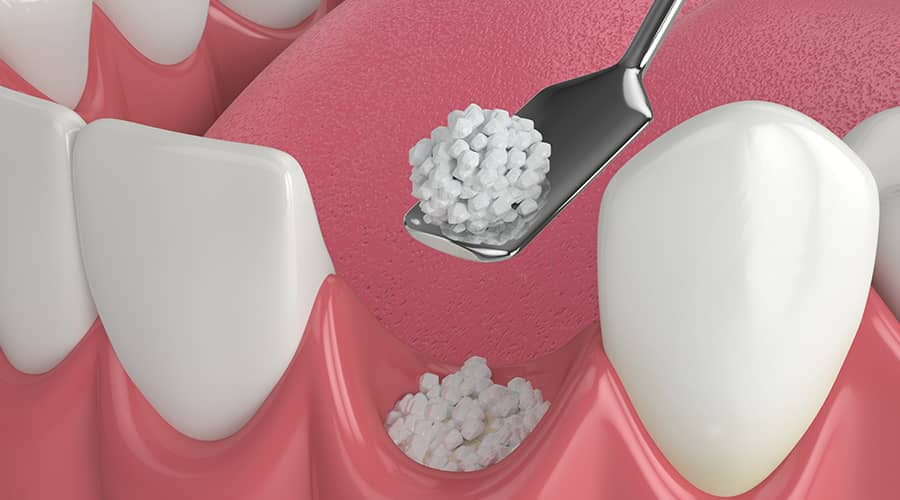
Bone loss in the jaw can occur after a tooth is removed, when a tooth has been missing for some time, or because of infection, periodontal disease, or trauma. Dental bone grafting rebuilds areas where bone has been lost and can create the support needed for future dental implant placement.
At Foley & Le Oral Surgery, bone grafting is carefully planned based on the location and amount of bone loss and your overall treatment needs.
Schedule a consultation with one of our board-certified oral surgeons.
Experienced Surgical Care
Dr. Benjamin Foley, Dr. Thao Le, and Dr. Michael Schiappa perform bone grafting procedures ranging from socket preservation after a tooth extraction to more extensive ridge augmentation and sinus lifts. Their training in oral and maxillofacial surgery allows them to plan bone grafting alongside tooth extraction and dental implant treatment when needed.
Building a Strong Foundation for Dental Implants
Dental implants need enough healthy bone around them to remain stable. If the jawbone is too narrow, too short, or has lost volume after tooth loss, an implant may not have adequate support.
Bone grafting adds material to the area where bone is deficient. As the site heals, your body forms new bone around and through the graft, creating a stronger foundation for implant placement.
Not everyone who receives a dental implant needs a bone graft. We use dental imaging to evaluate the height, width, and condition of your jawbone and determine whether there is enough bone for an implant or whether the area should be rebuilt first.
When Is a Dental Bone Graft Needed?
Bone grafting may be performed at the time of a tooth extraction or later to rebuild bone that has already been lost. The amount of grafting needed can range from preserving a single tooth socket to rebuilding a larger area of the jaw.
Common reasons for bone grafting include:
- Preserving bone after a tooth extraction
- Rebuilding bone that has been lost after a tooth has been missing
- Creating enough height or width for a dental implant
- Replacing bone damaged by periodontal disease or infection
- Rebuilding an area affected by dental or facial trauma
- Increasing bone below the sinus before implant placement in the upper back jaw
What Is Bone Graft Material Made Of?
The bone graft material used for your procedure depends on the area being treated and the amount of bone that needs to be restored. The three types of bone grafts used in dental bone grafting include:
- Autogenous grafts: Bone is taken from your own body. For larger grafts, the iliac crest in the hip may be used as a donor site.
- Allografts: Bone comes from a human donor. Donated bone is carefully processed and sterilized before it is used for grafting.
- Xenografts: Bone comes from an animal donor. These grafts are used less frequently in our practice.
Types of Dental Bone Grafting
The type of bone graft you need depends on where bone has been lost, how much needs to be rebuilt, and whether you are preparing for a dental implant.
Socket Preservation
Socket preservation is performed at the time a tooth is removed. Bone graft material is placed into the empty tooth socket to help maintain the height and width of the ridge as the area heals.
This is often recommended when a dental implant may be placed later. Preserving the bone at the time of extraction can reduce the amount of bone loss that occurs while the site heals.
Ridge Augmentation
Ridge augmentation rebuilds an area of the jaw that has already lost height, width, or both. It may be needed when a tooth has been missing for some time or when bone loss extends beyond a single extraction socket.
The goal is to restore enough bone volume to support future dental implant placement or another planned restoration.
Sinus Lift
A sinus lift may be needed when there is not enough bone in the upper back jaw to support a dental implant. The sinus membrane is carefully elevated and bone graft material is placed beneath it to increase the amount of available bone.
Depending on your anatomy and the amount of existing bone, implant placement may occur at the same time as the sinus lift or after the graft has healed.
Dental Bone Grafting and Implant Planning
Bone grafting is often one part of a larger dental implant treatment plan. The timing of the graft depends on how much bone is present when treatment begins.
For some patients, an implant can be placed at the same time as an extraction or bone graft. For others, the graft needs to heal first so there is enough stable bone to support the implant.
Our surgeons plan the surgical stages around the condition of your jawbone and the position of the future replacement tooth. The patient’s restorative dentist will restore the implant, we coordinate treatment so the surgical and restorative stages work together.
What to Expect During Dental Bone Grafting
Before your procedure, your oral surgeon will examine the area and review your dental imaging to evaluate the amount of bone present and determine where grafting is needed. Your medical history, medications, and anesthesia options will also be reviewed.
During the procedure, bone graft material is placed in the area where additional bone is needed. Depending on your treatment plan, bone grafting may be performed at the time of a tooth extraction, during dental implant placement, or as a separate procedure to rebuild an area of the jaw before an implant is placed.
Once the graft is in place, the area may be covered with a protective membrane and the gum tissue is closed with stitches when needed
Recovery and Healing
Soreness and swelling are expected after bone grafting and should gradually improve as the surgical area heals. You will receive post-operative instructions based on the type and extent of your procedure.
During the early stages of healing, it is important to protect the graft from unnecessary pressure or irritation. You may need to eat softer foods, avoid chewing directly over the surgical area, and temporarily limit strenuous activity.
You may occasionally notice a few small graft particles in your mouth during the first few days. This does not necessarily mean the graft has failed. Contact our office if you notice significant loss of graft material, increasing swelling or pain, drainage, or another change that concerns you.
Dental Insurance and Payment Options
If you have Delta Dental Premier or Cigna, your estimated portion is collected at the time of service. For all other plans, payment is due in full, and any insurance reimbursement will be sent to you once your claim is processed.
Financing options are also available through Cherry, which allows you to split treatment costs into manageable monthly payments.
Schedule a Consultation
If bone grafting is part of your treatment plan, our oral surgeons can explain the procedure, what to expect during recovery, and how it fits with any planned tooth extraction or dental implant treatment.
To book a consultation at our oral surgery office in Boulder, CO, call (303) 444-2255 or visit us at 1420 28th St, UNIT 100, Boulder, CO.
Call UsFrequently Asked Questions
Is a bone graft always necessary after a tooth extraction?
No. Whether you need a bone graft depends on which tooth is being removed, the condition of the surrounding bone, and what is planned for the area afterward. Socket preservation is commonly considered when a dental implant may be placed in the future.
Can a dental implant and bone graft be done at the same time?
Yes, in some cases. If there is enough existing bone to provide initial implant stability, additional graft material may be placed around the implant during the same procedure. If more extensive bone reconstruction is needed, the graft may need to heal before implant placement.
How long after a bone graft can I get a dental implant?
Many bone grafts require approximately three to six months of healing before implant placement. The timing depends on the size and location of the graft and how the new bone develops. Your surgeon will evaluate the area before proceeding with the implant.
Can your body reject a dental bone graft?
A dental bone graft can sometimes fail to heal or integrate properly. The risk may be higher in patients who smoke or vape, are immunocompromised, have had multiple surgeries in the area, or have a history of multiple sensitivities.
Can I get a dental implant without a bone graft?
Yes, if you have enough healthy jawbone to support the implant. Bone grafting is only recommended when additional bone is needed for proper implant placement and stability. Your oral surgeon will evaluate your jawbone with dental imaging when planning your implant treatment.
Where can I get a dental bone graft in Boulder?
Foley & Le Oral Surgery provides socket preservation, ridge augmentation, sinus lifts, and other dental bone grafting procedures at our Boulder office. Our surgeons can evaluate your bone with dental imaging and determine which approach is appropriate for your treatment plan.


